
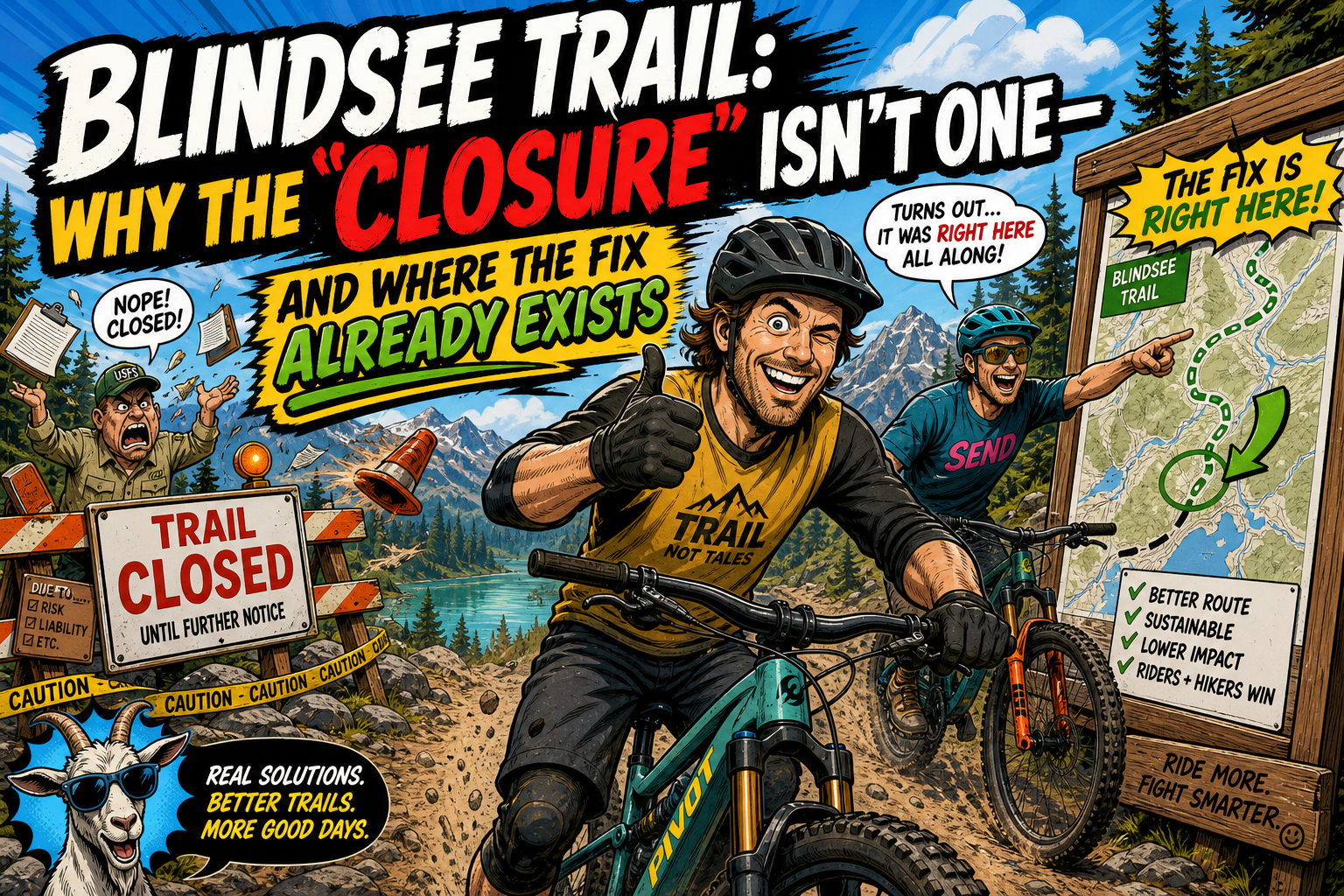
If the Blindsee Trail is on your Alps bucket list, you’ve probably seen the headlines: closed to bikes from 2027. Before you cross it off — or rush to tick it off this summer in a panic — read this. We went to the source, the mayor of Biberwier, and the real story is very different from the obituary doing the rounds. The Blindsee isn’t dead. It’s on probation. Here’s what’s actually going on, and why there’s genuine reason for hope.
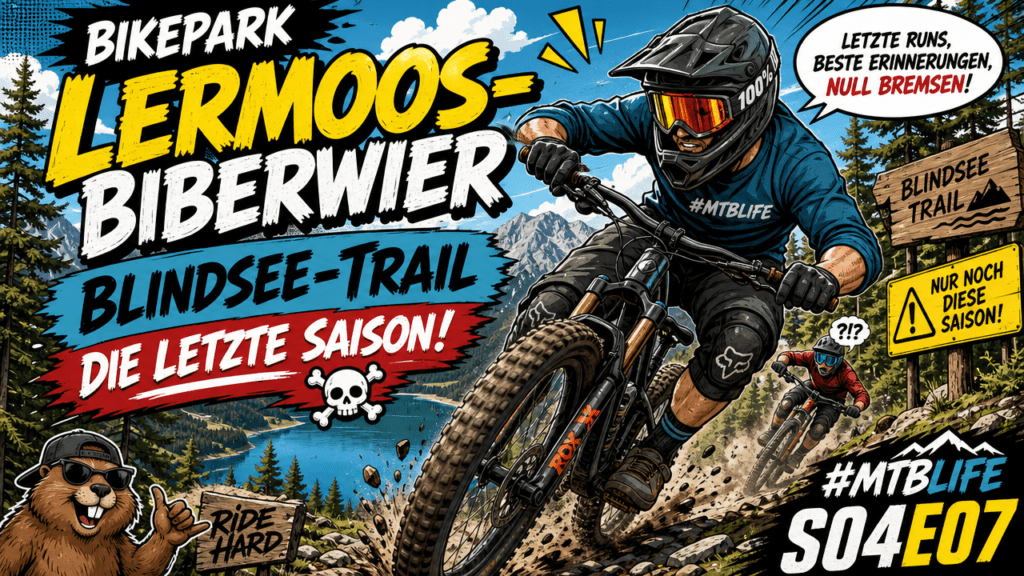
First, the trail itself, for anyone who hasn’t ridden it. The Blindsee sits in the Tiroler Zugspitz Arena, the cluster of villages — Lermoos, Ehrwald, Biberwier — tucked under the Zugspitze on the German-Austrian border, an easy hop from Garmisch and well within reach for a long weekend from the UK. Open since 2014, it runs roughly five miles with around 2,300 feet of descent, a natural, hand-built singletrack that spits you out at the Blindsee, a turquoise lake so clear it looks Photoshopped. You ride up via the Bergbahnen Langes lifts out of the Lermoos bike park, then drop out of the park and down to the water. It’s a proper Alpine classic, and it’s exactly the kind of trail people plan a trip around.
So when word spread that it was being shut, the reaction across the international forums wasn’t so much anger as bafflement: why couldn’t they find a way to make it work?
| What looks like a shutdown is really an ultimatum — with a survival clause built in. |
The bit you need to understand first: Austria isn’t Scotland
If you’re used to Scotland’s right to roam, or to riding public-land trails in the US, Austria works almost backwards. Here, cycling in the forest is forbidden by default. A trail only becomes legal when the landowner signs it over for biking — and that permission can be pulled. Walkers, by contrast, enjoy a legal right of access that no one can revoke. So whenever a shared trail gets tense, there is only ever one group that can be switched off: the bikers. That single legal asymmetry is the backdrop to everything that follows, and it’s why even a beloved trail can feel so fragile.
Tirol has tried to bridge that gap since 1997 with its “Mountain Bike Model,” and few regions run it as thoroughly as the Zugspitz Arena. The deal: landowners open their paths for bikes by contract, a partner organisation — a tourism board or the municipality — takes on the liability, and the regional government adds an insurance layer to cushion the risk. Whoever the contract makes responsible for upkeep becomes the legal “path keeper,” the central figure when it comes to maintenance and liability.
Reason one: a contract from another era
The real flashpoint is a contract signed about twelve years ago — back when both hikers and bikers at the Blindsee were a fraction of today’s numbers. From the municipality’s point of view, that old paper loads too much risk onto the town and, above all, onto the local commons association that owns the land. A contract built for 2014 simply doesn’t fit a trail that has since become one of the most-ridden natural descents in the Alps. Honest take: when liability, maintenance duties and risk are lopsided, asking for a new contract isn’t obstruction — it’s reasonable. The question is whether you cancel a bad contract to replace it with a better one, or cancel it and bury the trail in the process.
Reason two: the S5 trap — a clause that rewards neglect
One line in that contract explains why the trail’s condition has quietly worsened for years. It says, in effect, that the path must be maintained so that it stays at difficulty grade S5. Sounds harmless. It’s anything but.
Quick primer if you don’t live in grades: the Singletrail-Skala (STS), Europe’s technical-difficulty scale, runs from S0 (smooth, no obstacles) to S5 (the extreme end — boulder fields, loose rock, tight switchbacks, big drops). S5 is barely rideable even for very strong riders; think double-black and then some. Now turn that into a maintenance clause: the less work you do, the rougher and more broken the trail gets, the more reliably it keeps its S5 rating. Maintain it well, and you risk dropping below the grade the contract demands.
| The worse the trail is maintained, the more reliably it stays grade S5. A contract that rewards neglect. |
On a bike-only trail you might shrug. But the Blindsee shares its lower section with a popular lakeside walking loop — and a deliberately gnarly path is unpleasant and frankly unsafe for walkers. A clause meant to keep things clear now works against everyone sharing the trail. Nobody’s villain here; it’s a design flaw from another time.
Reason three: nobody whose actual job is to look after it
Here’s the part the debate keeps missing. The regional government coordinates the bike model but, by its own statement, builds and maintains nothing — that falls to municipalities, tourism boards and lift companies. And the money in the system is thin and aimed at the landowner, not the spade work: the government subsidises compensation of roughly 20 to 30 euro cents per linear metre per year, which offsets the owner’s burden but pays for no real trail care.
The Blindsee makes this worse, because it isn’t a tidy in-park lap. You reach the top through the Lermoos bike park, but the trail then leaves the park and runs down to the lake — into shared, public ground that belongs to no single lift company’s remit. A trail like that needs a custodian who thinks beyond lift boundaries. A strong volunteer outfit — a club that takes on upkeep, visitor management and conflict prevention — doesn’t currently exist on the spot. That’s the real gap. As it turns out, it’s also the real opportunity.
Where the picture flips
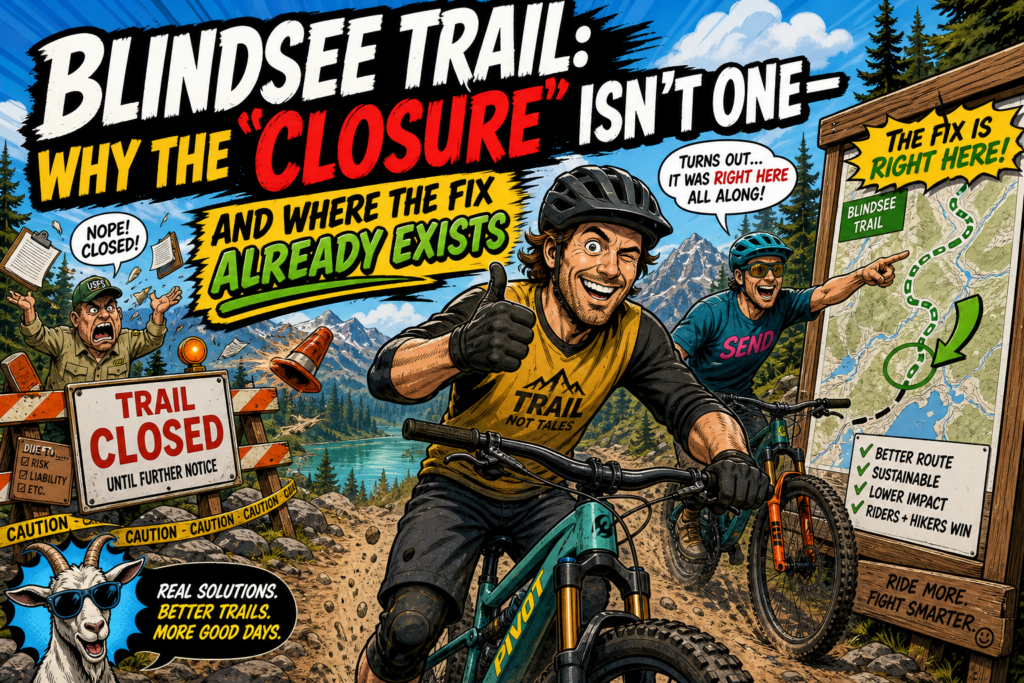
Now the twist. The council resolution is not a final “closed in 2027.” From everything we’ve seen, it cancels the old contract but explicitly couples that with a stated commitment to keeping the trail — on condition that the Tiroler Zugspitz Arena works up an improvement project together with the council, covering the whole section down to the lake, and that a new, modern contract is drawn up.
In plain terms: the broken old contract ends, but the door stays open — it’s just tied to homework. What everyone reported as a “closure” is really an ultimatum with a built-in survival clause. The mayor himself says he doesn’t expect it to actually come to a shutdown. That’s a very different tune from “we’ve pulled the plug.”
Fairness in all directions: the mayor’s account that too little workable came back over recent months is his side of the story. The tourism board has publicly backed keeping the trail and says it’s working to prevent the shutdown. We’ve asked them for their take too, and we’ll add it. Who contributed how much matters less than the fact that both want the same thing — the trail to survive.
The fix already exists — one valley over
Stack it all up and the outlook is surprisingly bright. There’s a political commitment to continuation, in writing. A technical fix for the biggest flashpoint — separating walkers and riders near the lake — has been walked through with the forestry authority and looks feasible. And the municipality is visibly investing in its own infrastructure. This is not a town trying to get rid of tourism. It’s a town trying to get rid of an old contract.
And the missing piece — the custodian who thinks beyond lift boundaries — doesn’t have to be invented. In the same district, in the Außerfern around Reutte, a volunteer mountain-bike club recently showed exactly how it’s done. Their project, a new trail area at the Urisee, was the first bike-trail development in all of Tirol built entirely by a club, and it’s free for everyone to ride. What’s remarkable isn’t just the result, but who sat at the table to make it happen: the municipality, the local commons association that owns the land, a crowd of volunteers, the regional tourism board and the provincial government with its funding.
| The blueprint for saving the Blindsee already exists one valley over — volunteer-built, with everyone at the table. |
Let that land, because it untangles the exact knot Biberwier is stuck on: over there, they brought a commons association on board as a partner — the very hurdle that looks insurmountable at the Blindsee right now. So it isn’t wishful thinking, it’s proven practice, that landowners, council, tourism and an organised rider community can jointly carry a trail that belongs to everyone. What the Blindsee lacks isn’t goodwill or feasibility. It’s a reliable partner on the rider side willing to raise a hand and say: we’ll look after it. The region has just shown it can produce exactly that.
Riders can move first, too. A voluntary “Blindsee Trail Code” — walk or crawl through the sensitive lakeside section, a friendly hello instead of a bell blast, easing off at peak swimming hours — costs nothing and signals everything. It’s not a list of demands aimed at the council; it’s a message: we’ll do our part. That’s what turns “they don’t follow any rules anyway” into “they’re part of the solution,” and takes the sharpest objection out of the landowners’ and hunters’ hands.
What it comes down to
The Blindsee Trail is the best argument against its own closure. A descent that has pulled visitors to the region for over a decade, a summer flagship that — as is now clear — can be maintained, defused and rebuilt with the right custodial model, does not belong shut. The 2026 season is the window: a proving season to show that a well-run shared trail, with clear rules and a community that pulls its weight, actually works.
We’re staying on this — solution-first, not a blame parade. Two special episodes of our #MTBlife podcast dig into the Tiroler Zugspitz Arena, with the Blindsee front and centre. Our goal isn’t to put one side in the dock. It’s to make sure this story ends not with a closed trail, but with a model for how hikers and bikers share the mountain. That’s a win for the region, for visitors, and for the sport.
If you love the Blindsee, ride it in 2026 with respect. Slow down where it’s tight. Say hello when you meet someone on foot. Every considerate run this season is a small piece of evidence — and maybe the most persuasive argument there is that this trail deserves a future.
MTB Report · Trail Access · Updated 17 June 2026 · mtb-report.com
- Paganella Part 1: The New TOP GUN Trail & Why I Skipped Lake Garda | #MTBlife S04E13

- The Million-Dollar Trail Town – and the Ban That Nearly Killed the Model
- MTBlife S04E09 | 3-Länder Enduro Trails Nauders – Ein Tag, drei Länder, ehrliche Trails
- The Derailleur Is Dying. The Wattage War Isn’t. Avinox MG vs. Gobao – Inside the Gearbox Fight
- Zugspitzpark Ehrwald – The Complete Guide for Your Visit
- Tiroler Zugspitz Arena MTB Geheimtipp am Fuß der Zugspitze – Biberwier & Lermoos #MTBlife
- Größter Indoor-Bikepark der Welt – die unglaubliche Geschichte von Ray Petro
- #MTBlife S04E04 — Bikepark Albstadt: Small, Honest, Weatherproof
- Atemberaubende FPV-Drohnenaufnahme zeigt Red Bull Hardline aus völlig neuer Perspektive
- Blindsee Trail: Why the “Closure” Isn’t One — and Where the Fix Already Exists
- While the rest of us argue about access, Austria just built a 10km flow trail
- A World-Class Alpine Trail Is Being Killed Off – And the Reason Should Worry Every Rider


No responses yet