
Published by Radical Life Studios / MTB Report
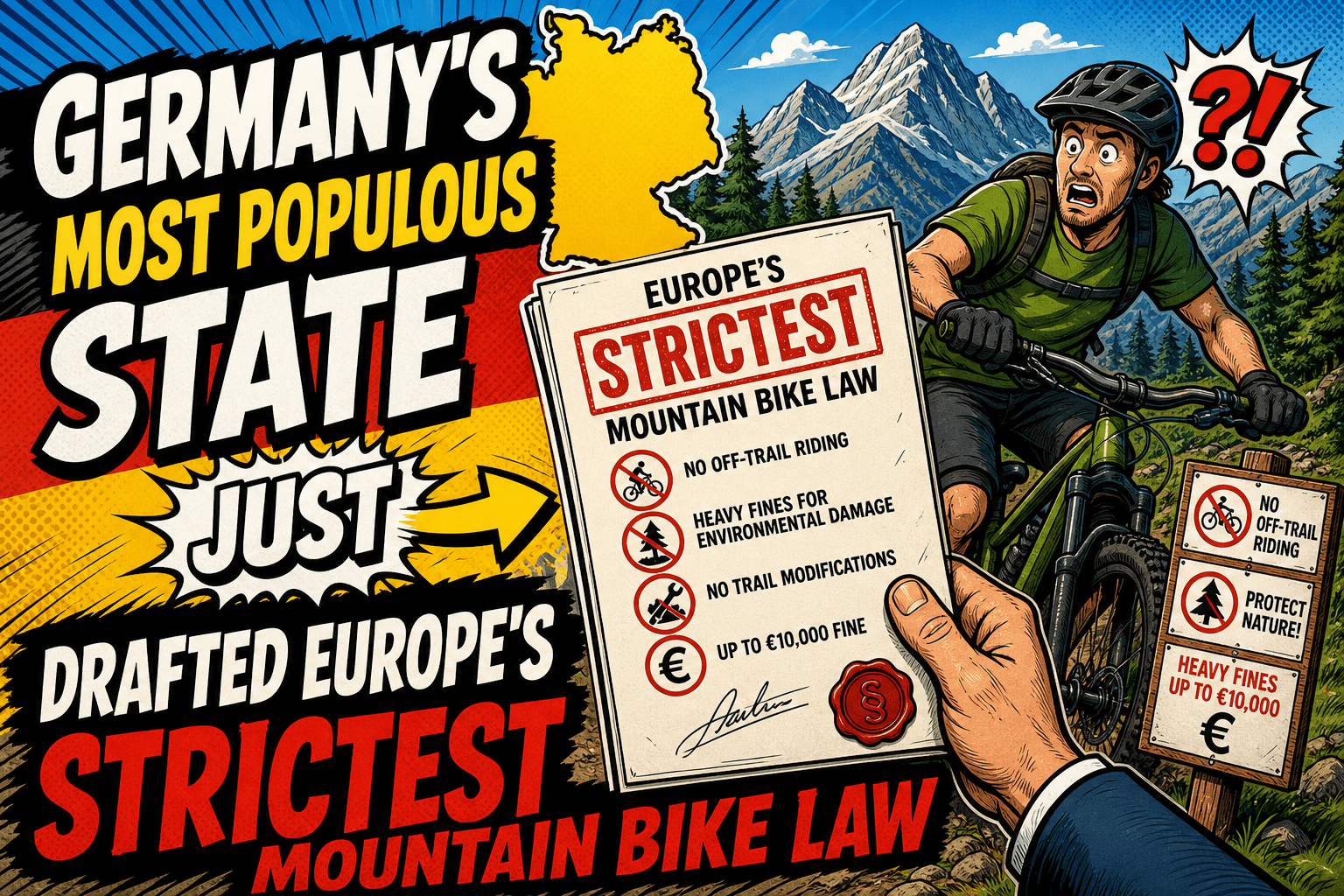
On 7 May, the state government of North Rhine-Westphalia — home to nearly 18 million people and a substantial chunk of Germany’s mountain bike community — tabled a draft forestry law that would effectively ban riding on anything narrower than a logging truck. Singletrack as we know it disappears. Building features becomes a standalone offence. The deadline for stakeholder responses is 8 June. If you ride anywhere in Europe — or anywhere with ongoing trail-access politics — this one matters.
What the draft actually says
Until now, mountain biking in NRW has been governed by a fairly liberal rule: bikes are allowed on „roads and solid paths.“ Vague enough that most well-established trails were rideable in practice.
The new draft, dated 7 May 2026, breaks with that. Under the proposed § 2 paragraph 2, cycling in the forest will only be permitted on „roads and forest tracks (Fahrwege), and on trails designated with the consent of the landowner and the forestry authority.“ Forest tracks are defined as „paved or naturally solid forestry roads.“
The explanatory text gets specific: these are paths „generally constructed so that they can be driven by two-track, non-off-road vehicles.“ Translation: passable by a regular car, or in practice, a logging truck.
The 3.5-metre rule no one is calling by its name
The draft explicitly references Germany’s 2023 forestry road-building directive, which sets the standard width for a Waldwirtschaftsweg at 3.5 metres of road surface, 4.5 metres including verge. Bake those numbers into law and the consequence is brutal: if the path is narrower than a working forest truck, it isn’t a „track“ — and you can’t ride it.
Narrower than a logging truck? Not a path. That’s the new logic, written down in black and white.
Some context for international readers: Germany’s most notorious trail-access regulation — Baden-Württemberg’s 2-metre rule — has been a sore point for three decades. NRW’s draft would not just match that rule. It would beat it by 1.5 metres and tie eligibility to vehicle access. It would be the harshest mountain bike regulation in any German federal state, and arguably the strictest in Europe.
Building features becomes its own offence
Buried in § 3 paragraph g is the second hammer. The draft makes it an explicit offence to „erect structures, fills, or ramps for the purpose of riding or cycling outside of designated trails,“ without landowner consent and proper authorisation.
On its own, that’s defensible. No serious advocacy organisation argues for unrestricted illegal trail-building on private land. The problem is the combination. With nearly every singletrack erased from the legal map, every well-intentioned drainage bar, every roller built by a local crew over the weekend, becomes a potential fine.
And the „official trail“ escape clause? Mostly theatre.
The draft allows for „designated trails“ — but only with the consent of both the landowner and the forestry authority. Anyone who has ever tried to push a single legal singletrack through the European bureaucratic gauntlet knows what that means in practice: landowner liability concerns, multi-year permitting, and queues.
What’s missing is any state-level commitment to actually deliver legal trail networks at scale. Baden-Württemberg, after thirty years of trench warfare, has at least made political noise about creating sanctioned singletrack. NRW’s draft is silent on the question. The word „trail“ appears in the law — but as a fig leaf, not a promise.
What the community is pointing out
The most damning observation comes directly from the DIMB, Germany’s national mountain bike advocacy group: why should a single-track bicycle be limited to paths sized for two-track motor vehicles? A mountain bike’s weight, width and ground pressure are closer to a hiker than a logging truck. The chosen yardstick has no rational basis.
Riders in the major German-language forums have flagged something equally awkward: the draft justifies the restriction by citing hiker-cyclist conflict — while simultaneously treating forestry roads, where logging trucks and walkers routinely share narrow surfaces, as the safe option. The internal logic doesn’t survive scrutiny.
The economic background helps explain it. Page one of the draft’s rationale is dominated by forestry-industry interests. Recreation, biodiversity, public access — treated as ancillary.
DIMB: „Stand as one“ — but coordinate before you act
The DIMB went public with its critique on 13 May, calling the draft a serious regression. The organisation is preparing a detailed response within the formal stakeholder consultation, which closes on 8 June.
Importantly, the DIMB is asking riders not to launch uncoordinated solo campaigns yet. Aggressive social media broadsides at this stage play into the „outlaw mountain bikers“ framing that some German media outlets are already reaching for. The fight for the next few weeks runs through advocacy organisations. They need backing — not freelance noise.
The timeline matters
This is the start of a long process, not the finish line:
- 7 May 2026: Draft tabled by the state government.
- 13 May 2026: Formal stakeholder consultation opened.
- 8 June 2026: Deadline for organisation responses.
- June–July 2026: Ministry review, cabinet draft.
- Summer/autumn 2026: Introduction to the state parliament, first reading.
So the legislative battle plays out from autumn onwards. Plenty of time to organise. Also plenty of time for the story to slip out of the headlines — which would be the worst possible outcome.
Why this matters beyond Germany
Trail-access policy is contagious. If NRW passes the strictest mountain bike regulation in Europe and survives the political fallout, that becomes the new ceiling for what’s possible elsewhere. Opponents of access — in the UK, where right-to-roam debates rumble on; in France and Italy, where bike park politics are sharper than the marketing suggests; and yes, in the US, where federal Wilderness designations and e-MTB classification fights run on similar lines — will point to NRW and say: this is reasonable. The Germans did it. Why not you?
It works the other way too. If the consultation pushes back hard and the draft is diluted before it reaches parliament, that’s a precedent in the other direction. Either way, what happens in a state legislative process most non-German riders have never heard of is going to matter for trail-access fights all over the continent — and arguably beyond.
The end-2023 federal forestry law attempt — which would have imposed similar restrictions across all of Germany — was stopped largely because the DIMB and allied organisations made enough noise at the consultation stage. Same playbook applies here. Same stakes.
The takeaway is uncomfortable but useful: trail access is never won. It’s only ever periodically defended. NRW is up now. Whichever forest you’re riding in tonight could be next.
MTB Report — Trail Politics & Scene · Updated 19 May 2026
- Paganella Part 1: The New TOP GUN Trail & Why I Skipped Lake Garda | #MTBlife S04E13

- The Million-Dollar Trail Town – and the Ban That Nearly Killed the Model
- MTBlife S04E09 | 3-Länder Enduro Trails Nauders – Ein Tag, drei Länder, ehrliche Trails
- The Derailleur Is Dying. The Wattage War Isn’t. Avinox MG vs. Gobao – Inside the Gearbox Fight
- Zugspitzpark Ehrwald – The Complete Guide for Your Visit
- Tiroler Zugspitz Arena MTB Geheimtipp am Fuß der Zugspitze – Biberwier & Lermoos #MTBlife
- Größter Indoor-Bikepark der Welt – die unglaubliche Geschichte von Ray Petro
- #MTBlife S04E04 — Bikepark Albstadt: Small, Honest, Weatherproof
- Atemberaubende FPV-Drohnenaufnahme zeigt Red Bull Hardline aus völlig neuer Perspektive
- Blindsee Trail: Why the “Closure” Isn’t One — and Where the Fix Already Exists
- While the rest of us argue about access, Austria just built a 10km flow trail
- A World-Class Alpine Trail Is Being Killed Off – And the Reason Should Worry Every Rider


No responses yet