
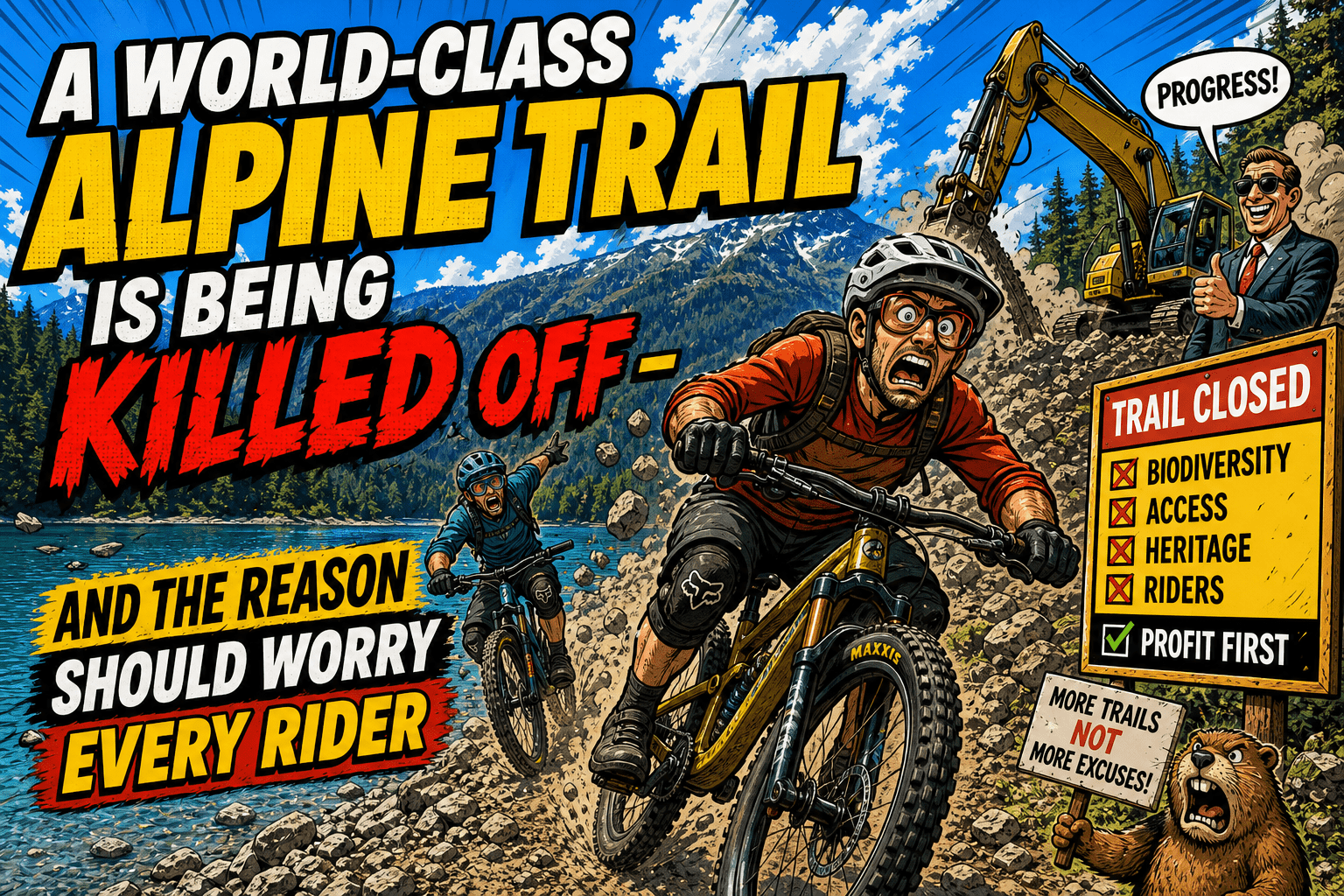
Published by Radical Life Studios / MTB Report
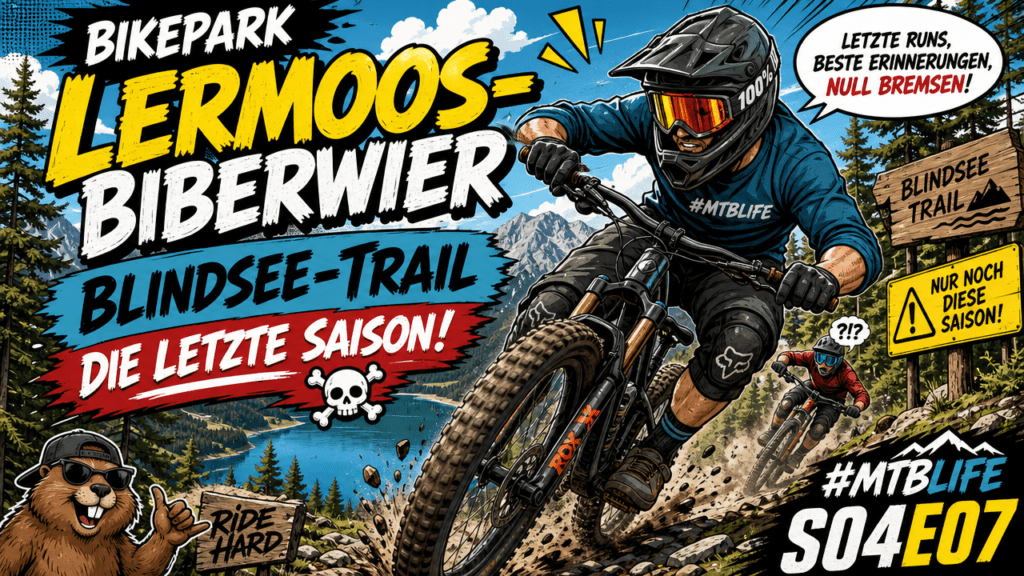
One of the most loved natural trails in the Alps is heading for the chop. The council of Biberwier, in Austria’s Tyrol, wants to close the legendary Blindsee Trail to mountain bikers from 2027. You can still ride it through the 2026 season – after that, it’s set to be gone. It looks like a small-town Tyrolean spat. It’s actually a case study in why trail access in Austria is so dangerously fragile in the first place.
What’s been decided
The Blindsee Trail has been one of the region’s headline acts since 2014: roughly 8.2 km (about 5 miles) of descent, around 710 m (2,300 ft) of vertical drop, a proper natural-trail feel, and the turquoise Blindsee lake waiting at the bottom as your reward. That’s the trail now on the chopping block.
According to regional newspaper reporting, Biberwier’s council has voted for the closure – unanimously, as it stands. The trail stays open for the current 2026 season, then shuts to bikes from 2027. As yet there’s no detailed official rationale published by the municipality, so the picture rests for now on press reports and early comments from the town hall.
Why it’s being closed: the shared-trail problem
The crux sits in two words: shared trail – a route used by hikers and bikers at the same time. In the council’s view, that simply no longer works here. The lower section runs right past the popular Blindsee lake, busy in summer with walkers, swimmers and families. Put fast descending riders and strolling pedestrians on the same strip of dirt and friction is guaranteed.
Local reporting points to rising aggression and recurring conflicts. The council’s conclusion is blunt: if coexistence on one trail doesn’t work, the trail gets closed.
| “Shared trails don’t work.” That, in five words, is the council’s position. |
The mayor has pointed the finger squarely at the regional tourism board, saying the problems have been known for about a year and too little was done. The tourism board, for its part, is hoping to head off the closure of one of its flagship attractions. So the final word may not be spoken yet – even if the decision points firmly toward a shutdown.
The Austrian catch – why every trail has to be “bought” first
Here’s the part international riders need, because it explains why this happens faster in Austria than almost anywhere else you’ll travel to ride.
In most places riders take some baseline access for granted. Scotland has its right to roam; in the US the fight is over which public lands bikes (and e-bikes) may use. Austria flips the default entirely. Under the 1975 Forest Act, anyone may enter the forest on foot – walking, hiking, running. Cycling and mountain biking are not covered. To ride, you need the explicit permission of the landowner or the party responsible for the path.
In plain terms: in the Austrian forest, riding is forbidden by default unless it’s expressly allowed. Every legal trail has to be contractually opened up – effectively “bought” – before a wheel turns. There doesn’t even need to be a “no biking” sign; the ban is the baseline. Ride where you shouldn’t and you’re looking at administrative fines and, in theory, civil claims for trespass.
Then there’s the second lever: liability. Once a path is officially opened to bikes, the owner or path-keeper can be on the hook for its condition. Combine “banned by default” with “open it up and you carry the risk,” and legal trails in Austria are structurally shaky. A municipality that wants to dodge hassle and liability always has the easy exit within reach: lock the gate.
| In Austria, it isn’t the ban that’s the exception – it’s the permission. That’s exactly what makes any trail so easy to lose. |
What the scene is saying
Across the forums and comment threads the reaction is loud – and split. As riders there report, plenty rate the Blindsee Trail among the best free descents in Austria, full stop. The grief runs deep, and so do the voices writing Austria off wholesale as bike-hostile and rerouting their next trip to Italy or Switzerland.
Others push back – and hit a nerve. Riders who loudly call to boycott the region and let it “milk the tourists” elsewhere are, in many bikers’ eyes, handing over the exact ammunition used to justify closures. Others note from experience that the upper, more technical section rarely sees a hiker at all; the real conflict is concentrated on that final stretch by the lake.
Switzerland keeps coming up as the counter-example, where coexistence on shared paths often seems to work far better. The question hanging over the debate: is it really just the riders – or also a system built to separate and channel rather than to share?
| Publicly calling to boycott a region tends to write the justification for the next closure for you. |
Our take
The Blindsee closure is more than a sad footnote for Alps-bound holidaymakers. It shows how fast a flagship built over more than a decade can collapse when the legal foundation was sand from day one. As long as riding is the exception that someone has to actively permit and insure, every trail hangs on the goodwill of individual owners and councils.
And yes – the riding community should be honest enough not to wave away its own share. Recklessness by the lake, blasting through walkers, the tone of some online pile-ons: all of it plays into the hands of those who’d rather funnel everyone into the nearest pay-to-ride bike park anyway. Trail etiquette isn’t a buzzkill; it’s trail preservation in its most practical form.
But the sober truth stands: a council that takes the easy road and closes, instead of working with its tourism board, landowners and advocacy groups toward something workable, loses more than a trail in the end. It loses trust – and guests.
What you should know right now
- Still rideable in 2026: As it stands, the Blindsee Trail remains open this season. If you want to experience it, don’t leave it forever.
- Check the status first: The situation is fluid and an official rationale is still pending. Before you travel, look up the latest and heed the signage on the ground.
- Ride like a guest: The lower section by the lake is full of pedestrians. Drop the speed, say hello, yield – on a shared trail that’s the deal, not a favour.
- Understand Austria: Riding in the forest is only legal on designated routes. Knowing that keeps you out of trouble – and helps protect the trails that are still standing.
MTB Report · Trail Access · As of 31 May 2026 · mtb-report.com
- Paganella Part 1: The New TOP GUN Trail & Why I Skipped Lake Garda | #MTBlife S04E13

- The Million-Dollar Trail Town – and the Ban That Nearly Killed the Model
- MTBlife S04E09 | 3-Länder Enduro Trails Nauders – Ein Tag, drei Länder, ehrliche Trails
- The Derailleur Is Dying. The Wattage War Isn’t. Avinox MG vs. Gobao – Inside the Gearbox Fight
- Zugspitzpark Ehrwald – The Complete Guide for Your Visit
- Tiroler Zugspitz Arena MTB Geheimtipp am Fuß der Zugspitze – Biberwier & Lermoos #MTBlife
- Größter Indoor-Bikepark der Welt – die unglaubliche Geschichte von Ray Petro
- #MTBlife S04E04 — Bikepark Albstadt: Small, Honest, Weatherproof
- Atemberaubende FPV-Drohnenaufnahme zeigt Red Bull Hardline aus völlig neuer Perspektive
- Blindsee Trail: Why the “Closure” Isn’t One — and Where the Fix Already Exists
- While the rest of us argue about access, Austria just built a 10km flow trail
- A World-Class Alpine Trail Is Being Killed Off – And the Reason Should Worry Every Rider


No responses yet