
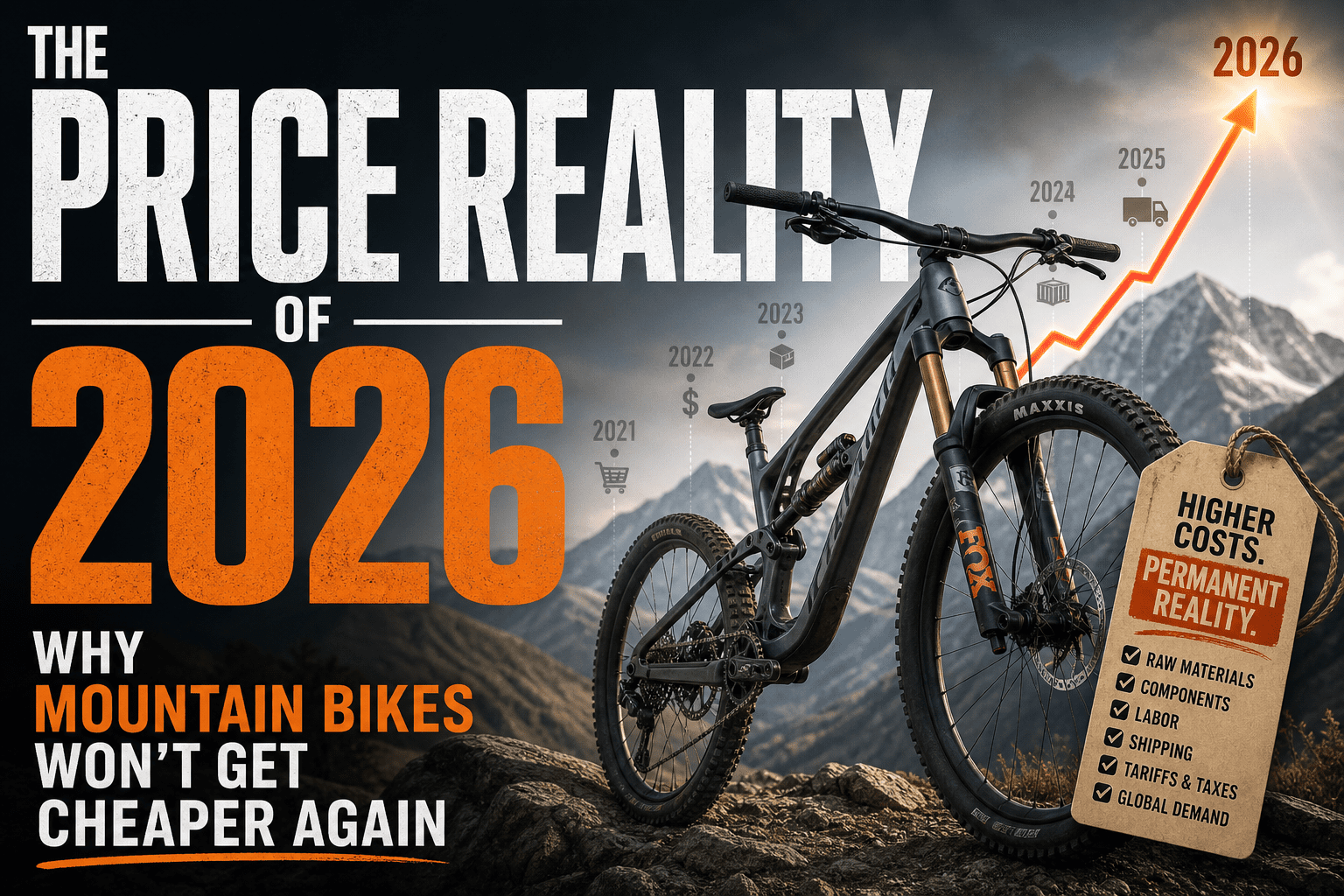
A stabilized market, higher production costs, and a new economic baseline for the entire industry.
Published by Radical Life Studios / MTB Report
After years of turbulence, the mountain bike industry enters 2026 with something that looks like stability — but not the kind riders hoped for. Prices are no longer rising dramatically, but they aren’t falling back to pre-boom levels either. The discounts of 2023 and 2024, when brands attempted to clear enormous overstock, have disappeared. What remains is a new, firmer price structure that reflects the true cost of producing modern bikes.
The industry spent the last years correcting itself. Manufacturers reduced inventories, reorganized supply chains and cut product lines. But the global cost base never returned to what it once was. Raw materials like aluminum and rubber remain significantly more expensive than in the pre-pandemic era. Shipping has stabilized but not cheapened. Labor costs in Taiwan, Vietnam and Europe continue to rise. Even carbon production — once the holy grail of efficiency — now carries higher environmental and regulatory costs.
All of this means that the „cheap bike“ era is over. Not because brands don’t want to reduce prices, but because the ecosystem they operate in has changed. The cost of creating a frame, a damper, a motor or a drivetrain is simply higher than it used to be, and these costs flow directly into the retail price.
What also changed is the design philosophy. Bikes are more complex, integration is deeper, and electronics have become the norm rather than the exception. A modern E-MTB carries not only hardware, but firmware, sensors, gyroscopes, safety protocols and diagnostic systems that must be supported for years. This additional technological layer is part of the price riders pay in 2026 — not just for the bike, but for long-term service, updates and parts availability.
Another factor is that brands learned from the chaos of the oversupply crisis. Nobody wants warehouses full of unsold bikes again. Production volumes for 2026 have been intentionally reduced, allowing companies to keep prices stable instead of being forced zu fire-sale discounts. What many riders interpret as „inflation“ is actually a return to controlled, deliberate production rather than mass output.
Tourism, trail building and infrastructure investments also influence the bigger picture. Regions investing in bike parks, trail networks and sustainable outdoor projects rely on stable pricing and industry health. A market full of dumping prices might look attractive for consumers short-term, but it undermines the long-term stability of the sport.
By the beginning of 2026, the message from the industry is clear:
Bikes won’t get cheaper — but they will get better. More durable frames, improved suspension, smarter electronics, safer batteries and longer support cycles all justify a market that has matured into a realistic economic zone.
For riders, this means adjusting expectations. Bargain hunting becomes harder, but planning becomes easier. Prices are not collapsing anymore, brands aren’t panicking, and the industry is building a foundation that finally feels sustainable after years of volatility.
Mountain biking isn’t returning to the past.
It’s entering its first truly stable economic decade.
Global Bicycle Market Recovery Signals:
https://www.bicycleretailer.com/
https://www.statista.com/topics/1112/bicycle-industry/
Industry Cost Analyses / Supply Chain Reports:
https://www.pinkbike.com/
https://www.bike-eu.com/
Economic Trends in Components & Materials:
https://asia.nikkei.com/
https://www.metalbulletin.com/
E-Bike Systems & Long-Term Support Trends:
https://www.bosch-ebike.com/
https://www.shimano.com/
- Paganella Part 1: The New TOP GUN Trail & Why I Skipped Lake Garda | #MTBlife S04E13

- The Million-Dollar Trail Town – and the Ban That Nearly Killed the Model
- The Million-Dollar Trail Town – and the Ban That Nearly Killed the Model
- MTBlife S04E09 | 3-Länder Enduro Trails Nauders – Ein Tag, drei Länder, ehrliche Trails
- The Derailleur Is Dying. The Wattage War Isn’t. Avinox MG vs. Gobao – Inside the Gearbox Fight
- The Derailleur Is Dying. The Wattage War Isn’t. Avinox MG vs. Gobao – Inside the Gearbox Fight
- Zugspitzpark Ehrwald – The Complete Guide for Your Visit
- Tiroler Zugspitz Arena MTB Geheimtipp am Fuß der Zugspitze – Biberwier & Lermoos #MTBlife
- Blindsee Trail: Why the “Closure” Isn’t One — and Where the Fix Already Exists
- Größter Indoor-Bikepark der Welt – die unglaubliche Geschichte von Ray Petro
- #MTBlife S04E04 — Bikepark Albstadt: Small, Honest, Weatherproof
- Servus … Grüezi … Hallo … (Radio Edit)


No responses yet