
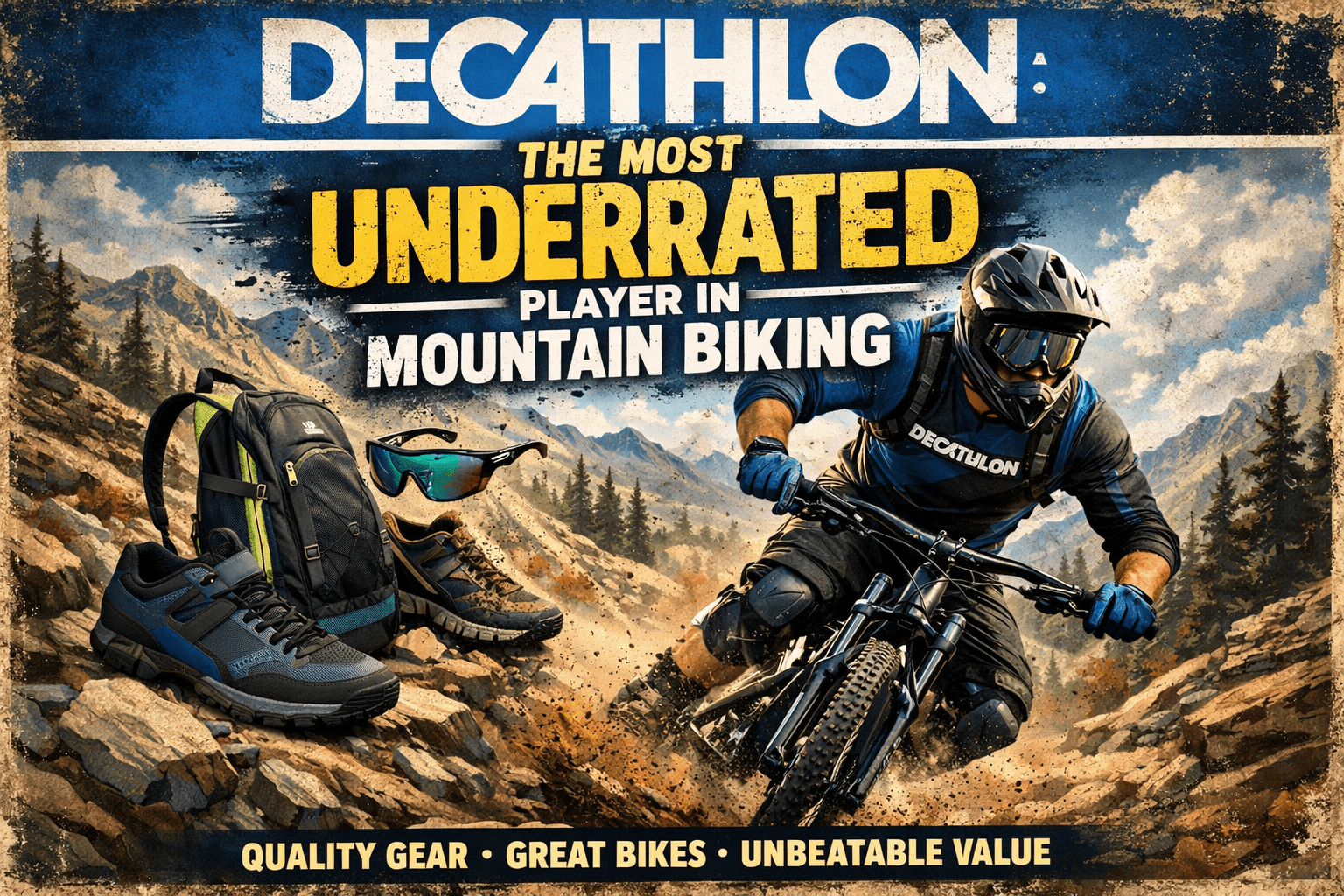
A budget giant quietly turning into a technical heavyweight.
Published by Radical Life Studios / MTB Report
Decathlon has always been present just never truly seen.
For years, the global retail giant was treated as the “beginner brand,” the place where newcomers bought their first bike before upgrading to something more serious. But quietly, methodically, and with far more engineering intent than most riders realize, Decathlon has transformed itself into one of the most disruptive forces in mountain biking.
The shift began when the company restructured its in-house brand Rockrider.
What used to be simple entry-level bikes suddenly appeared with geometry charts that mirrored high-end models, modern angles, clean cable routing, and suspension packages that no longer belonged in the bargain bin. Riders and reviewers started asking a question no one expected:
“Why is this €1,500 bike performing like something twice its price?”
Unlike traditional brands, Decathlon doesn’t follow the classic industry model.
There are no distributors, no dealer networks, no middlemen.
Engineering happens in-house, production is tightly controlled, and retail is direct.
Every step removed from the chain becomes savings and these savings land directly on the bike.
What makes this moment so interesting is not that Decathlon makes cheap bikes.
It’s that they now make good bikes technically relevant, competitively engineered, and accessible at prices the rest of the industry cannot match without sacrificing margin.
The company has also embraced a new design philosophy.
Instead of chasing niche categories, Rockrider focuses on clear, versatile platforms:
aggressive hardtails, competent trail bikes, and increasingly refined full-suspension models that appeal not only to beginners but to riders who simply want value without compromise.
Meanwhile, Decathlon is investing heavily in suspension partnerships, battery development for e-MTBs, and even frame testing labs that rival those of premium brands. The brand is no longer content being “the affordable option.” It wants to compete.
The community reaction is fascinating.
Some riders still dismiss the bikes because of the name.
Others especially those who ride them know better.
In forums across Europe and beyond, more riders are discovering that performance doesn’t always come with prestige. Sometimes it comes from a warehouse with blue walls.
The broader industry cannot ignore Decathlon anymore.
When a brand with global distribution, massive purchasing power and efficient logistics decides to take mountain biking seriously, it shifts the entire price structure of the market.
And the truth is simple:
Decathlon isn’t the future underdog of mountain biking.
It’s the future benchmark.
Decathlon Rockrider Official Bikes:
https://www.decathlon.com/collections/rockrider
Engineering & R&D Insights:
https://www.decathlon-university.com/
https://www.pinkbike.com/news/
Community Experiences:
https://www.reddit.com/r/mountainbiking/
https://www.mtb-news.de/forum/
- The Million-Dollar Trail Town – and the Ban That Nearly Killed the Model

- MTBlife S04E09 | 3-Länder Enduro Trails Nauders – Ein Tag, drei Länder, ehrliche Trails
- The Derailleur Is Dying. The Wattage War Isn’t. Avinox MG vs. Gobao – Inside the Gearbox Fight
- Zugspitzpark Ehrwald – The Complete Guide for Your Visit
- Tiroler Zugspitz Arena MTB Geheimtipp am Fuß der Zugspitze – Biberwier & Lermoos #MTBlife
- Größter Indoor-Bikepark der Welt – die unglaubliche Geschichte von Ray Petro
- #MTBlife S04E04 — Bikepark Albstadt: Small, Honest, Weatherproof
- Atemberaubende FPV-Drohnenaufnahme zeigt Red Bull Hardline aus völlig neuer Perspektive
- Blindsee Trail: Why the “Closure” Isn’t One — and Where the Fix Already Exists
- While the rest of us argue about access, Austria just built a 10km flow trail
- A World-Class Alpine Trail Is Being Killed Off – And the Reason Should Worry Every Rider
- Flow Line Bikepark Albstadt – kompletter Uncut-Run für Einsteiger





No responses yet