
Published by Radical Life Studios / MTB Report
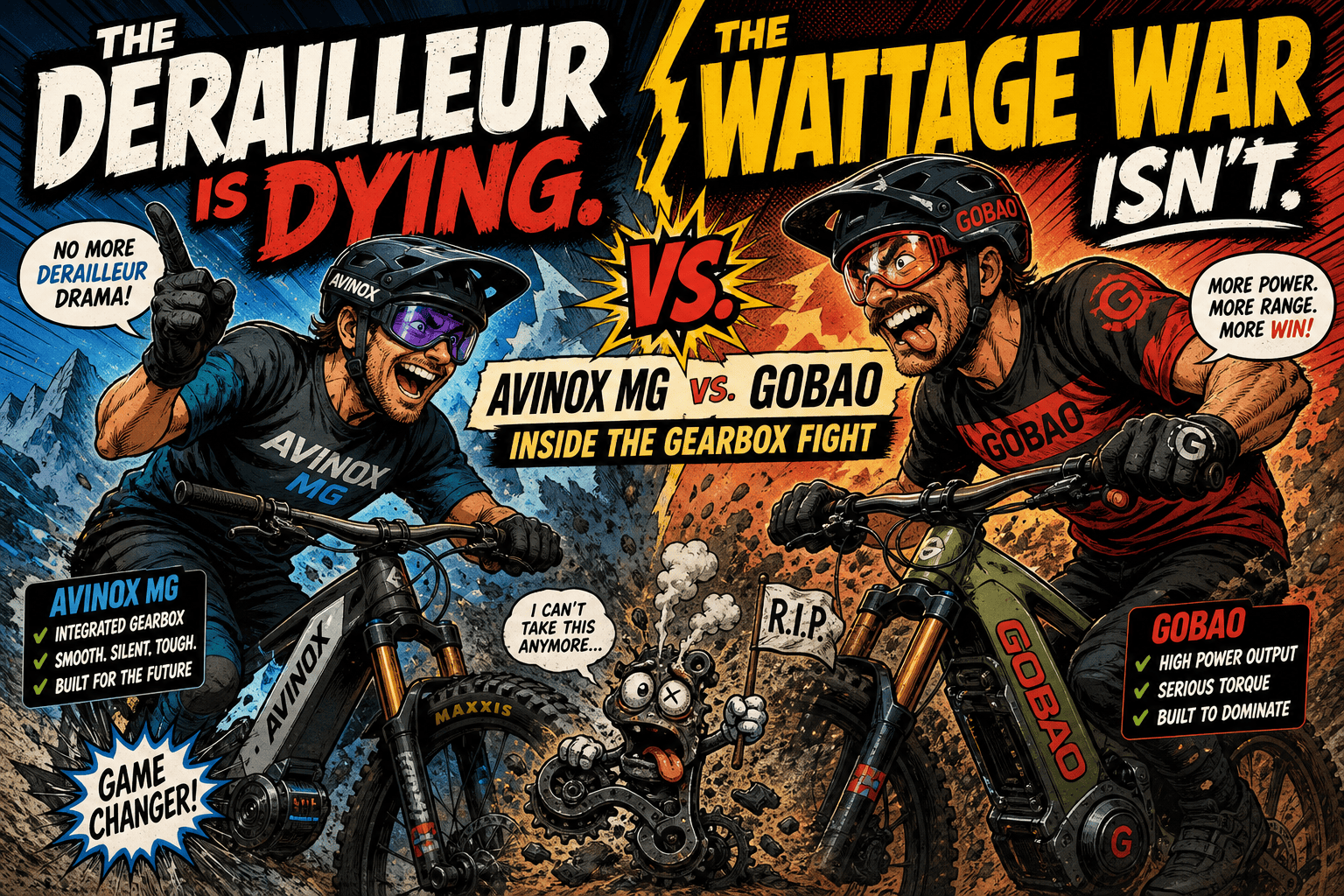
At Eurobike 2026, two manufacturers just called time on the classic derailleur drivetrain for eMTBs: Avinox unveiled its MG Concept, a motor with a built-in stepless gearbox, while newcomer Gobao rolled out a system that already looks surprisingly production-ready. For everyday riders, this is genuinely great news. If only it weren’t wrapped in another round of the wattage war.
Two Motors, One Message
What sounded like sci-fi for years suddenly showed up twice in Frankfurt: the e-bike motor with the gearbox built in. No derailleur dangling off the back, no cassette, no stepped shifts – instead, an eCVT, an electronically controlled, continuously variable transmission living inside the motor housing. If that acronym means nothing to you: instead of jumping between fixed gears, the system adjusts the ratio constantly and seamlessly. You just pedal – the software keeps your cadence where you want it. Prefer to shift yourself? Both systems let you define virtual gears and click through them from a bar remote. But you don’t have to.
The core idea isn’t new – Pinion’s MGU has combined motor and gearbox for a while, albeit with fixed gears, and Decathlon’s Owuru drive already went stepless on city bikes. What is new: the concept has now arrived in the performance eMTB segment with full force, and it’s two Chinese companies slugging it out over it while Bosch, Shimano, and SRAM watch from the sidelines.
Gobao? Never Heard of Them – That’s About to Change
The name Gobao means nothing to most riders. But the company from Dongguan didn’t exactly play it humble at Eurobike: a massive booth, placed – of all spots – on Bosch’s former floor space, directly opposite Avinox. And here’s the spicy part: industry chatter has it that a number of former Avinox staffers now work at Gobao. That’s not a coincidence. That’s a declaration of war.
The X-System comes in two flavors. The Gobao X1 delivers 120 Nm of torque and 1,200 watts of peak power with a 400% gear range, aimed at city and trekking bikes. The X1P is the eMTB weapon: 150 Nm, 1,500 W peak, 500% range. Both units weigh 3.85 kg (8.5 lb), undercutting Pinion’s MGU. For context: a 500% range is roughly what a modern 12-speed drivetrain covers – everything from a bailout climbing gear to full-speed sprinting is in there.
On top of that, Gobao brings a fast-charging system that raises eyebrows: with the 1.5 kW charger, the 750 Wh battery is claimed to go from 10 to 80% in about 20 minutes – several times faster than the established players manage. Series production is slated for February 2027. What Gobao doesn’t have yet: any major bike brand publicly committed to the system.
Avinox MG Concept: A Suspiciously Quick Answer
Avinox – the e-bike brand out of the DJI universe – only launched its new M2 and M2S motors in April. Less than three months later, the MG Concept lands on the show floor: a motor-gearbox unit based on the M2S, meaning up to 150 Nm and 1,500 W of peak power. The transmission works steplessly across a range of up to 520%, shifts are claimed at under 0.1 seconds – at a standstill, under full load, even multiple gears at once. Avinox also promises up to three times the drivetrain durability, 10% better efficiency, and, for the first time, regenerative braking that feeds energy back into the battery on descents. How those numbers were measured, the company won’t yet say – it’s a concept, not a finished product.
Still, things are further along than the word “concept” suggests: prototype frames from Canyon, Commencal, Forbidden, Mondraker, and Megamo – all built specifically around the new unit – were sitting on the booth, and Avinox says the first production bikes should arrive in 2027. And yet there’s an aftertaste. When the market leader rushes out a half-baked concept while the challenger across the aisle shows rideable prototypes, that doesn’t look like confident product strategy. It looks like a company that has to take its new rival very seriously.
| “When a market leader pulls an unfinished concept out of a hat, that’s not product strategy – that’s nerves.” |
Why This Is Good News for You
Let’s be honest: the derailleur is the weakest link on a modern eMTB. It hangs exactly where rocks, roots, and crashes aim, it wears out faster under motor power than on an acoustic bike, and replacing it hurts your wallet. A sealed gearbox in the motor solves several problems at once: all the delicate parts sit protected in an oil bath, the chainline stays straight – or gives way to a low-maintenance belt – there’s less unsprung weight at the rear wheel, which your suspension will thank you for, and the classic rock-garden derailleur sacrifice becomes a thing of the past. For newer riders and high-mileage riders who don’t want to spend every other weekend wrenching, this might be the most sensible drivetrain innovation in years.
It’s not all upside, though. CVT-style transmissions have traditionally been a touch less efficient than a well-maintained chain drivetrain, which can cost range. If the unit fails, you’re not replacing an $80 derailleur – you’re potentially into the whole block. And you’re tying yourself even more tightly to a single manufacturer’s ecosystem: motor, shifting, battery, app, all from one vendor also means all in one vendor’s hands. Neither company is talking prices yet, either.
Now for the Catch: 1,500 Watts
As much as we like the gearbox idea, we can’t stand the frame it arrives in. Both systems anchor their top versions at 150 Nm and 1,500 W of peak power – the headline figure Avinox established with the M2S, and apparently now the bar every new drive unit has to clear. In Europe, this stays street-legal because the rated continuous output sits at 250 W. In the US, it collides head-on with the debate around the Class 1–3 system, where access for e-bikes hinges on power limits and clear definitions – the very thing industry veteran Hans Rey called for earlier this year in his open letter to the bike industry, warning that ever-escalating peak power puts Class 1 trail access at risk. He’s right. A pedal-assist bike with the peak output of a small moped is exactly the image land managers, hiking associations, and legislators have in mind when they debate trail closures and tighter rules – whether that’s a US Forest Service district or an Austrian alpine valley. We’ve said it before: the future of the eMTB lies in light, efficient motors with modest output – more bike, less moped. And here’s the irony: a stepless transmission would be the perfect partner for exactly that philosophy, because it keeps the motor permanently in its most efficient operating range. Instead, it’s being burned as fuel in the wattage war.
| “The derailleur is dying. Sadly, the wattage war isn’t.” |
What Riders Are Saying
The community has been chewing on this for days, and the mood is split. Plenty of riders consider a derailleur on a high-powered eMTB an anachronism anyway – the phrase “it’s ridiculous to hang a derailleur on a motored bike” sums up a common sentiment – and welcome that someone is finally getting serious. Skeptics push back: higher cost, open questions on efficiency and long-term durability, and the worry of being locked into a single manufacturer for motor, gearbox, and battery alike. The automatic mode is drawing early criticism too: in higher ratios, the system pushes toward the speed limiter at fairly low cadence – fine for commuting, but sporty riders on trails want to spin faster. What’s striking, though: even many riders who are critical of the eMTB power race think the gearbox integration itself is the right move. The argument isn’t about whether – it’s about how.
So Who Wins This Fight?
Oddly enough, the newcomer currently looks more mature: Gobao showed a rideable, remarkably quiet system with hard numbers and a production date, while Avinox showed a promising but vague study – backed, however, by five big-name bike brands and the market muscle of more than 60 partner brands running its motors. For us, the bigger story is a different one: the future of the eMTB drivetrain is being negotiated between two Chinese companies, while the industry’s legacy giants are, at best, spectators. By 2027, when the first production bikes roll out, we’ll know whether the derailleur on eMTBs is truly on borrowed time. We’d bet that it is – and we’d love to see the second generation of these gearbox motors prove that innovation doesn’t need 1,500 watts.
- The Derailleur Is Dying. The Wattage War Isn’t. Avinox MG vs. Gobao – Inside the Gearbox Fight

- Zugspitzpark Ehrwald – The Complete Guide for Your Visit
- Tiroler Zugspitz Arena MTB Geheimtipp am Fuß der Zugspitze – Biberwier & Lermoos #MTBlife
- Größter Indoor-Bikepark der Welt – die unglaubliche Geschichte von Ray Petro
- #MTBlife S04E04 — Bikepark Albstadt: Small, Honest, Weatherproof
- Atemberaubende FPV-Drohnenaufnahme zeigt Red Bull Hardline aus völlig neuer Perspektive
- Blindsee Trail: Why the “Closure” Isn’t One — and Where the Fix Already Exists
- While the rest of us argue about access, Austria just built a 10km flow trail
- A World-Class Alpine Trail Is Being Killed Off – And the Reason Should Worry Every Rider
- Flow Line Bikepark Albstadt – kompletter Uncut-Run für Einsteiger
- Marienberg Trail, Biberwier: My Test Trail – and Why Riding Flat Out Downhill Is Hard Work
- STATERA Black Forest Trail — Sasbachwalden’s Hammer Line in the Ride Check | #MTBlife S04E02

No responses yet