
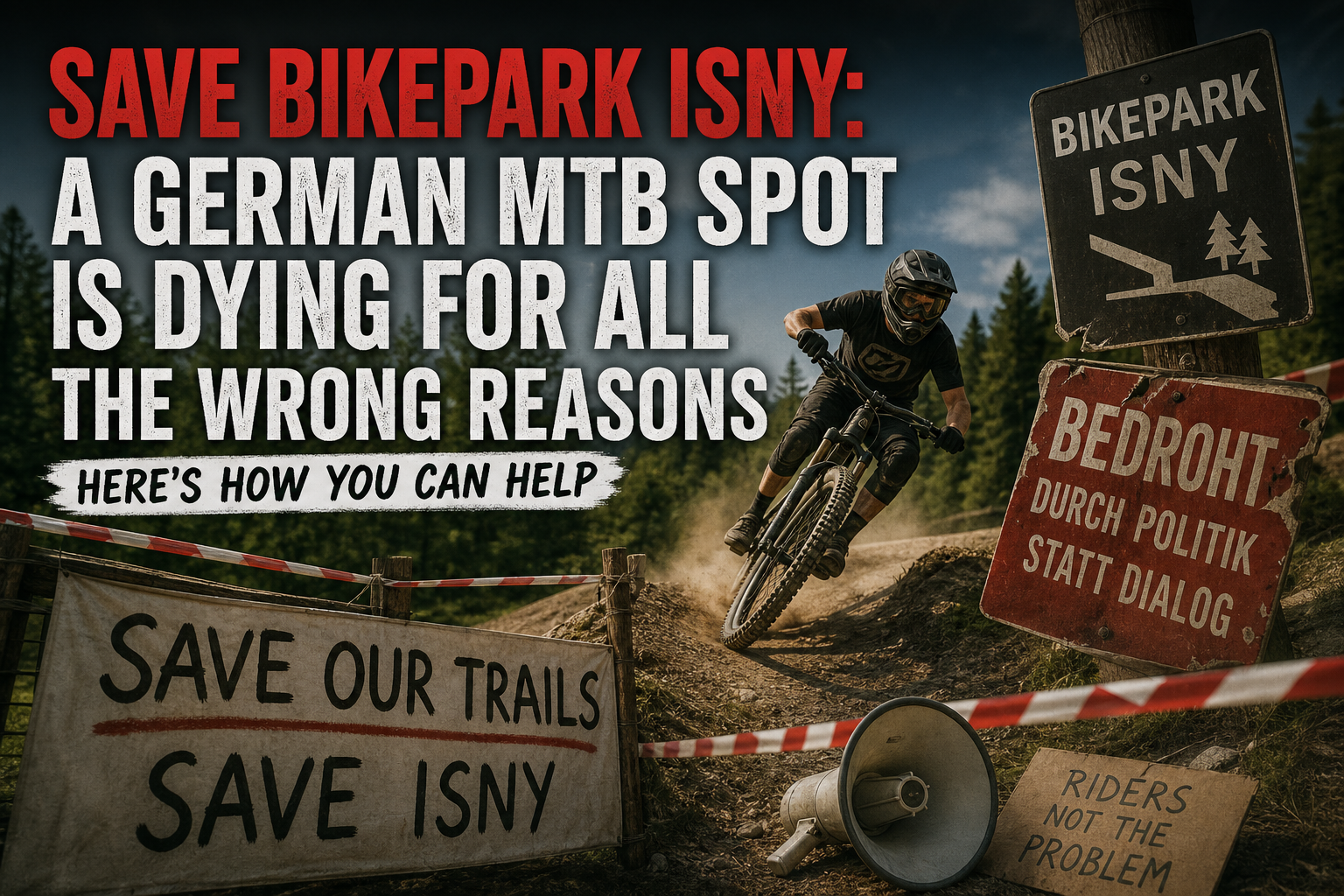
A skiing splash contest. A handful of furious neighbours. A Lutheran pastor as the landlord. And just like that, a complete bikepark in southern Germany is being shut down – with the bulldozers already rolling. Here’s the story of Bikepark Max Wild Arena Isny, why its closure should worry every mountain biker in Europe, and what you can do about it from anywhere in the world.
Published by Radical Life Studios / MTB Report
TL;DR The Max Wild Arena in Isny – a year-round venue with three downhill lines in summer and a family ski slope in winter – has cancelled its entire 2026 bike season. The trigger was a noise complaint over a winter ski event. The trails themselves are still standing. A petition is running, currently at 2,517 signatures. International signatures count too. Sign it.
Where this is happening – and why it matters
Isny is a small town in the Allgäu, the Alpine foothill region of southern Germany. Think rolling green hills, dairy farms, lederhosen, and a 50-minute drive to Lake Constance. It’s not Whistler. It’s not Lenzerheide. It’s the kind of unspectacular regional spot where local kids learn to ride. Where the bikepark sits inside the town, walking distance from the supermarket. Where a mountain biking infrastructure exists not because of tourism dollars but because someone bothered to build it.
That’s exactly what makes its closure significant.
Since spring 2020, the Max Wild Arena has run three lines on the Felderhalde, the town’s home hill: a Flow Line for beginners, a Pro Line for intermediates, and the Wilde Kerle („wild boys“) line for everyone who wants to send it. All trails were designed by German MTB pro Guido Tschugg. There’s a uplift, a rental fleet, lessons. In winter, the same hill becomes a family ski slope with its own snowmaking. A 365-day operation in the middle of a town – the kind of project urban planners across Europe write white papers about.
It’s all on hold.
The trigger: A skiing splash contest
The conflict between operators and neighbours has been simmering for years. What finally broke it open had nothing to do with mountain biking. On 28 February 2026, the Arena hosted a Watersplash Contest – the kind of end-of-season ski event where riders schuss down the slope and skim across a pool of cold water. Crowd cheers, music, the works. Neighbours called it unbearable. The police showed up.
Then came the kicker: even Isny’s Lutheran pastor, Dietrich Oehring, weighed in publicly to condemn the noise. Why does that matter? Because the Lutheran church owns the Felderhalde slope. They lease it to the operating company. So when the landlord starts publicly complaining about the tenant, you’re no longer in noise-complaint territory. You’re in lease-renewal territory. That changes the stakes considerably.
„Without a bikepark, riders just go cross-country through the forest again.“
— Klaus Geißler-Hauber, Managing Director, Max Wild Arena
Here’s the irony – mountain biking isn’t even the problem
This is the part that should make every European MTB advocate spit out their coffee. According to direct conversations local journalists had with the protesting neighbours, they don’t actually have a problem with mountain bikers. What bothers them:
- The roar of snow cannons and grooming machines (piste-bashers / snow cats)
- Car and motorcycle traffic to a popular cheese-farm restaurant at the foot of the hill
- Large events like the watersplash contest with late-night PA systems
The bikepark is collateral damage. It’s being shut down as part of a broader retreat by an operator who – understandably, after years of friction – has decided to make a point. A piece of legal, sanctioned mountain biking infrastructure is being dismantled because of a conflict that has very little to do with mountain biking. That’s not just frustrating. It’s a pattern that’s repeating itself across Europe.
The bulldozer story: what’s actually being demolished
You’ll see photos circulating online of excavators on the slope. Headlines have framed this as „the bikepark is being torn down.“ That’s not quite accurate – and the operator has clarified the situation directly.
Yes, some trails at the foot of the hill are being levelled. No, those are not the actual bikepark lines. What’s coming out is a small kids‘ play area with a beginner pump-track-style feature that was never formally permitted by the city. It was tolerated, never approved. The city has now ordered it removed for code-compliance reasons – an entirely separate matter from the neighbour dispute.
The three real lines – Flow, Pro, and Wilde Kerle – remain fully intact. That’s the most important fact in this entire story. Because it means a return to operation is genuinely possible. The hardware is still there. The lift is still there. The trail surface is still there. What’s missing is political will – on the operator side, the neighbour side, and the city side – to put everyone in a room and sort it out.
That’s exactly what the petition is trying to force.
What the community is saying
The local response has been overwhelming and largely furious. Local Facebook groups are full of comments echoing each other:
„Once again a leisure project gets killed by a few people.“
„There are jobs hanging on this. Companies. Tourism. Clubs. Families. Kids.“
The local ski club WSV Isny – the venue’s main winter user – has formally come out in support, calling for a roundtable between operators, neighbours, and the city. The mayor has positioned himself clearly in favour of finding a solution. The city itself contributed €17,450 in subsidy for the 2025/26 winter season. There’s institutional weight behind keeping this place open.
The petition itself is full of comments that read like every MTB forum thread you’ve ever scrolled through:
„It’s outrageous that a few cranks want to destroy the town’s main asset.“
And – critically – the same thing every MTB advocacy group from IMBA to the German DIMB has been saying for two decades:
„Without a legal park, riders just spread out into the woods. That’s worse for everyone.“
Why this should worry mountain bikers everywhere
This isn’t a parochial Allgäu problem. It’s a textbook case of how European mountain biking infrastructure dies. Pin it to your office wall:
- Bikepark gets built with significant local investment and permitting. (Isny: opened 2020.)
- Friction with neighbours develops – usually not over the riders themselves, but the surrounding infrastructure (parking, music, snowmaking, traffic).
- Communication breaks down. By the operator’s own admission, direct conversations with neighbours had stopped before the closure.
- One incident escalates everything – a louder-than-usual event, a police call, a viral noise complaint.
- The bikepark is the weakest link in the financial and political chain. It’s the first thing to go.
You’ve seen variations of this story play out across Britain, Switzerland, Austria, France, and the United States. The names change. The pattern doesn’t.
What makes Isny unusual – and worth fighting for from outside Germany – is that the trails are still there. This isn’t a post-mortem. It’s a hostage situation. And the hostage can still walk out alive if enough public pressure piles up.
How to help, right now
The petition runs on openpetition.de, the largest civic petition platform in the German-speaking region. It accepts international signatures. Currently sitting at 2,517 signatures, which is solid for a town of 14,000 but trivial compared to the size of the European MTB community.
Three things you can do:
🟢 Sign the petition: Petition to save the Max Wild Arena (openpetition.de)
🟢 Share it: WhatsApp groups, Discord servers, club newsletters, Strava posts. Every signature from outside Germany sends a message: this isn’t a parochial dispute, it’s part of a Europe-wide pattern that mountain bikers are watching closely.
🟢 Speak up: A comment under a local news post, a polite Instagram message to the Arena’s social channels saying you’d ride there, a quick line of support to the WSV Isny ski club. The more visibility this gets, the harder it becomes to quietly close the doors.
The petition won’t fix the underlying conflict between operators, the city, and the neighbours. That requires a roundtable, hard conversations, and probably someone backing down on the watersplash format. But the petition can shift the political wind. It can show the mayor and city council that backing the bikepark isn’t a niche position – it’s the popular one.
What happens next
The next few weeks will tell. The mayor is publicly behind keeping the venue open. The city has financial skin in the game. The trails are still in the ground. The lift is still bolted to the mountain. What’s missing is a structured conversation, and that requires public pressure to make happen.
We’ll keep an eye on this and update as things develop. In the meantime: sign, share, speak up.
🔗 Sign the petition:
openpetition.de/petition/online/petition-zum-erhalt-und-zur-unterstuetzung-der-max-wild-arena-in-isny
- The Million-Dollar Trail Town – and the Ban That Nearly Killed the Model

- MTBlife S04E09 | 3-Länder Enduro Trails Nauders – Ein Tag, drei Länder, ehrliche Trails
- The Derailleur Is Dying. The Wattage War Isn’t. Avinox MG vs. Gobao – Inside the Gearbox Fight
- Zugspitzpark Ehrwald – The Complete Guide for Your Visit
- Tiroler Zugspitz Arena MTB Geheimtipp am Fuß der Zugspitze – Biberwier & Lermoos #MTBlife
- Größter Indoor-Bikepark der Welt – die unglaubliche Geschichte von Ray Petro
- #MTBlife S04E04 — Bikepark Albstadt: Small, Honest, Weatherproof
- Atemberaubende FPV-Drohnenaufnahme zeigt Red Bull Hardline aus völlig neuer Perspektive
- Blindsee Trail: Why the “Closure” Isn’t One — and Where the Fix Already Exists
- While the rest of us argue about access, Austria just built a 10km flow trail
- A World-Class Alpine Trail Is Being Killed Off – And the Reason Should Worry Every Rider
- Flow Line Bikepark Albstadt – kompletter Uncut-Run für Einsteiger



No responses yet